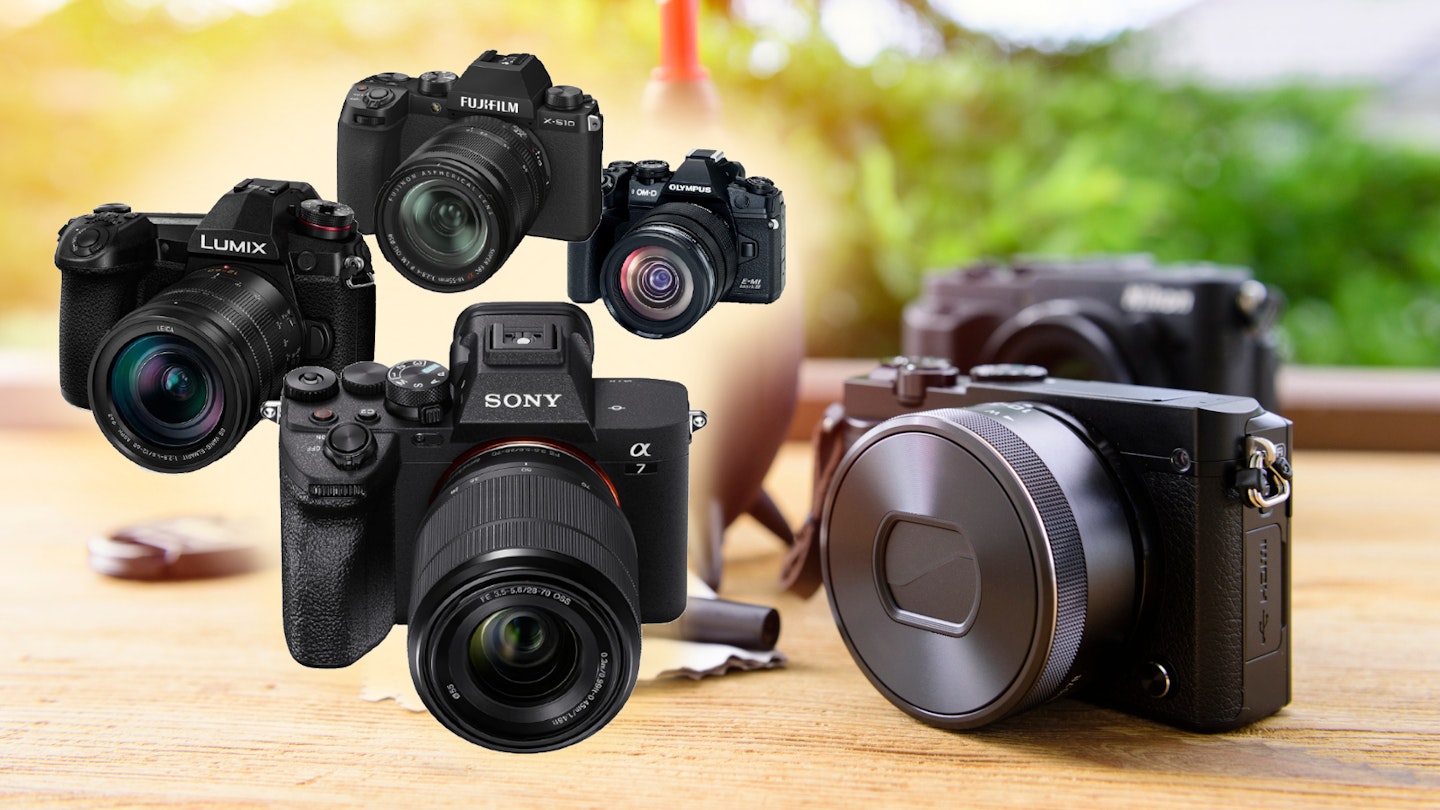
Not much bigger than a point-and-shoot compact, but featuring a sensor the same size as a D-SLR and interchangeable lenses, is Sony on to a winner with the Alpha NEX-5?With the arrival of the Sony Alpha NEX-5, Sony is muscling its way into the growing Compact System Camera (CSC) market. The NEX-5’s compact design and lack of a built-in viewfinder puts it up against the likes of the LUMIX GF1 and Olympus PEN range, notably the E-PL1. It’s currently the smallest CSC out there, but in an effort to reduce its size, has there been a compromise in terms of performance and handling?
Features & buildThe NEX-5 is a new system from the ground up and features a freshly developed 14.2Mp APS-C sized CMOS sensor – so it’s the same physical size as those found in most Sony D-SLRs and bigger (by roughly 50%) than the Micro FourThirds sensors found in both the Olympus PEN and Panasonic G-series models.
The lens mount is also completely new, too. The new E-mount is only a few millimetres shorter in diameter than Sony’s Alpha D-SLR lens mount, but unlike the Alpha mount, the E-mount is 100% electronic. With no AF motors in the body and the flange-back distance (the distance from the front of the mount to the sensor) reduced to just 18mm compared to 44mm on an Alpha D-SLR, it’s allowed the body to be incredibly compact, with a depth of only 25mm at its narrowest point. Though the lens mount is new, the multiplication factor of 1.5x remains the same as other Sony D-SLRs with an APS-C sized sensor. As a result, the supplied 18-55mm lens will offer a 35mm focal length equivalent of 27-82.5mm.
There’s no getting away from the fact that the NEX-5 is incredibly compact – even more impressive when you realise that the rear screen can be angled outwards and downwards – while even with the handgrip, the footprint is just 111x38mm. The design probably isn’t quite as engaging on first viewing as the original Olympus PEN E-P1 or Panasonic GF1, but it looks stylish nonetheless. One obvious thing is the lack of buttons and dials placed around the body – not including the on/off switch, there are only six buttons and a small scroll wheel.
It may be small, but it’s still comfy in the hand thanks to a well-proportioned handgrip, while the magnesium body adds to the high-end feel. It’s also worth mentioning that the supplied 18-55mm kit lens has a decent finish, too. There’s a metal lens mount at the rear, while the finely grooved zoom and manual focus ring also add to the quality. If there’s one downside it’s lens size – compared to the body it’s fairly hefty and not much smaller than a D-SLR lens of the same focal length range.
The newly-developed Exmor APS HD CMOS sensor offers an impressive ISO range of 200- 12,800, while the NEX-5 can shoot up to a maximum of 7fps (frames per second) in Speed-priority Continuous mode, though the exposure and AF is locked at the first shot.
In an effort to reduce size in the body, there’s no built-in anti- shake system. This is now incorporated in the lens, with the 18-55mm model featuring Sony’s Optical SteadyShot to reduce camera shake.
The 3in screen at the rear is the sole option for composition – there is an optical viewfinder available but it’s only suitable for the 16mm pancake lens. As with all other CSC cameras, the NEX-5 uses a contrast-detect AF system, with a choice of three AF areas to choose from – Multi, Centre and Flexible Spot. The NEX-5 also features HD video, allowing you to record up to 1920x1080 at 30fps in MPEG-4, though AVCHD is available, too.
Performance & handlingSony makes no bones about the fact that the NEX-5 is aimed at those wanting to make the step up from a compact, so even though the NEX-5 has a D-SLR sensor, its handling has been inherited from the compact sector. Almost every shooting option is set via the NEX-5’s menu, rather than the various buttons dotted round a D-SLR.
Once you’ve fired-up the NEX-5 (which isn’t instant) and hit the Menu option (highlighted on the rear screen), you’re presented with six options: Shoot Mode, Camera, Image Size, Brightness/Color, Playback and Setup. Shoot Mode gives you access to the NEX’s core shooting modes that include M, A, S, P, Scene, Intelligent Auto and Sweep Panorama – all done via a slick animated dial navigated with the scroll wheel. Set to Intelligent Auto, pretty much everything is set automatically, but those using the more creative shooting options have them spread over three sub-categories. Camera has access to AF settings and other minor options, Image Quality lets you set the quality for both still and video capture, while Brightness/Color features settings for ISO, White Balance and Metering among other things. This means it can be a bit fiddly to use quickly – for instance, you have to drill down
four clicks to toggle the ISO sensitivity, and it’s a similar story with other settings, too. Ideally there’d be a dedicated Quick menu button to get to a range of key settings quickly.
Once you’ve set up the NEX-5 to your desired settings, it’s pretty straightforward – it’s simple to use the scroll wheel to adjust shutter/aperture range, while the +/- Exposure Comp controls are easy to set, too. Intelligent Auto mode features a Background Defocus feature that uses the scroll wheel to move between Crisp and Defocus – the NEX-5 will adjust the aperture and at the same time produce a live preview of how the depth-of-field will be rendered, thanks to some clever in-camera processing. Clever stuff, but the Crisp setting means the lens is stopped all the way down to f/22-32, so you’re unlikely to be getting the best from the optics.
The TruBlack 3in screen is incredibly crisp, with a resolution of 921k dots, and the ability to angle the screen for waist-level and overhead shooting can be a real benefit in some situations. The AF system is solid for a contrast-detect system – focusing is responsive with minimal hunting, and it’s easy to move the AF point around the screen in Flexible Spot if you want to focus off-centre.
Value & VerdictAt £589 for the 18-55mm kit option, it’s currently a touch pricier than the equivalent Panasonic GF1 kit and just over £100 more than the Olympus PEN E-PL1. Though it’s the more expensive option, we can expect the price to drop after launch, and the more crucial factor is the difference in sensor size.
The APS-C sensor is larger than the equivalent Micro FourThirds chip, and the quality of results show that benefit. Noise is really well handled – especially at high ISOs where its rivals can’t match it – nor for that matter can the Samsung NX10, the other CSC to use an APS-C chip. Detail is also excellent, allowing you to confidently print at Super A3 and still get quality results.
You’re not short-changed for features, either, with a stack of creative settings that would leave some D-SLRs wanting.
What hasn’t been quite as successful is the handling; in Intelligent Auto it’s fine as a sophisticated point-and-shoot, but for those looking for a camera to use when their D-SLR is too bulky, it might become frustrating due to the over-complicated menu and slow access to settings.
As an engineering feat, the Sony NEX-5 is admirable – squeezing a large APS-C chip into a small and compact body is a fantastic achievement, while the quality of the results sets a new benchmark in this class.
Image qualityWith a 14.2Mp APS-C CMOS sensor at the heart of the NEX-5, detail is very good, producing a native file size of just over 40MB when opened in Photoshop. This allows you to print large, Super A3 (329x483mm) prints at 240ppi without the need to enlarge the file. This matches the Samsung NX10, but beats the 34MB output from Micro FourThirds options.
AT A GLANCEStreet price: £589 (with 18-55mm)
Resolution: 14.2Mp (4592x3056 pixels)
Lens mount: Sony E-mount
Focal length magnification: 1.5x
Focusing: Continuous, Single, Direct Manual Focus, Manual Focus
Burst rate: 7fps (7 RAW & 100 JPEG)*
Write times: 1.5secs (RAW), 1sec (JPEG)
ISO range: 200-12,800
Shutter range: 30secs-1/4000secs
Monitor: 3.0in, 921k dots TruBlack LCD
Live View: Yes
HD video: Yes: 1920x1080 @ 30fps
Storage: SD/SDHC/SDXC, Memory Stick PRO Duo/PRO-HG Duo
Weight (body only): 229g
Dimensions: 111x59x38mm
Visit: www.sony.co.uk